

Carl Schultz


Audio By Carbonatix
Whether you’re a fine art appreciator, holiday gift shopper, amateur artist or simply art-curious, the 29th annual Hidden in the Hills Artist Studio Tour over the last two weekends in November is a way to get up close and personal with local artists in their homes and studios.
The event showcases art in dozens of mediums, from large-scale sculptures and paintings to photography, jewelry, pottery, fiber art and more.
Organized by the Sonoran Arts League, the free, self-guided tour runs from 10 a.m. to 5 p.m. from Nov. 21 to 23 and 28 to 30. It features 164 artists in 41 studios this year, all within about 10 square miles in Carefree, Cave Creek and North Scottsdale.
“It’s a great opportunity for people to come and see how we work, where we work, and learn about the processes we go through,” says metal sculptor Carlos Page of Cave Creek. “It provides a very different experience than going to the gallery, in which you see the finished product, but you don’t have any more information on who created it.”
Map out a plan
Glass artist Carole Perry, a Sonoran Arts League board member and host artist for all 29 years, recommends researching in advance to map out a plan. The 180-page, full-color, glossy directory is available online, or you can pick it up for free on tour days at the studios.
Perry urges people to choose wisely and look for art that speaks to them, whether it’s abstract, contemporary, surreal, Western or even wearable art. Although it’s not a juried show — any member of the Sonoran Arts League can pay to participate — many artists on the tour have won major awards and are featured in corporate collections and museums.
“We encourage people to go to the website and pick the artists that they want to see and outline their tour ahead of time so they know which studios they want to go to,” Perry says. Aim to visit six to eight studios per day, she adds.
Be sure to allot time to engage with the artists, Perry advises. They enjoy discussing what inspires them and how they make a living doing what they love.
“People come directly to the source and have an opportunity to communicate and converse and hear our stories,” Page says. “Many people are interested in how we got started, what are our motivations, what are our goals (and) to learn about the creative process.”
Page added that many featured artists also teach classes and workshops, and people can get information while on the tour.
“For people to see our tools, see our places, see how we put pen to paper or whatever the media is, makes it a little more accessible and encourages some people to try,” he says.
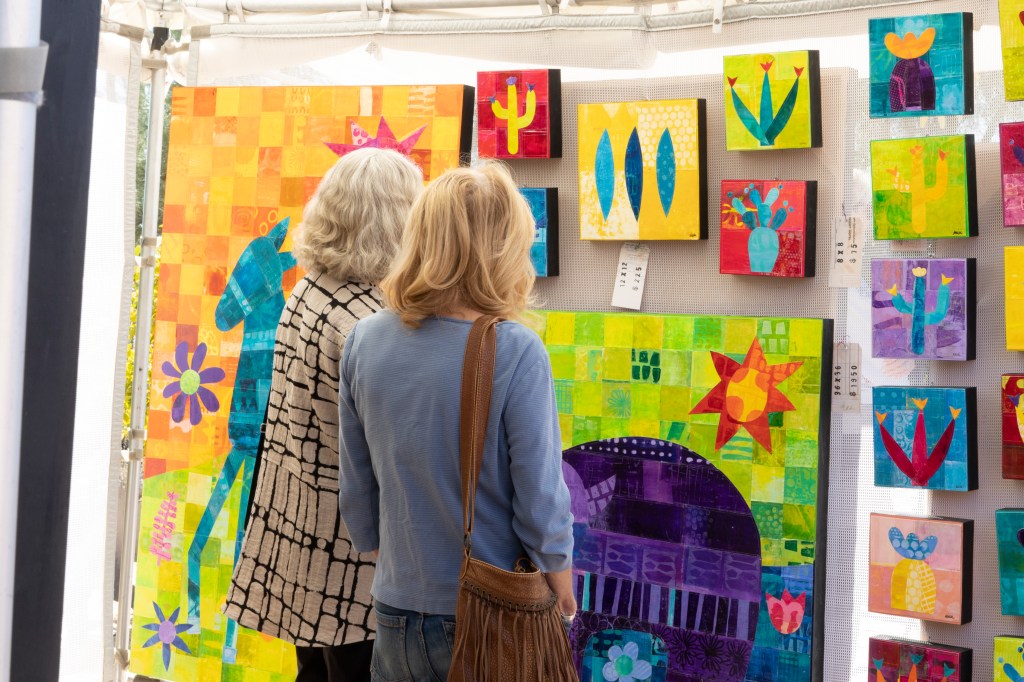
Jules Gallatig/Middle Red Studios
Be a looky-loo
Even if you’re not in the market for art, it’s worth it just to look. Perry says the main mission for the Sonoran Arts League is to generate a stronger appreciation of art. Sales are a bonus.
“Visual arts are critical to people’s mental health and well-being,” she says.
The setting itself is a draw as well. Nestled in the far north foothills, the natural environment is among the most beautiful in the Valley, making for an ideal day trip.
Also, many people go to gawk at the jaw-dropping custom houses that dot the landscape. The homes and studios themselves can be works of art.
Perry’s exterior walls around her pool, for example, are painted purple, orange and lime green, and a vintage swimming pool provides a centerpiece.
“People go crazy with laughter when they come into my yard,” she says, “because it looks like an artist’s house.”
Hosts arrange for plenty of parking, so it’s not a problem, she adds.
Although host galleries put out refreshments, Perry says the most common question she gets as a host is, “Where can we get something to eat?” She points out that at the back of the directory is a dining guide featuring all the restaurants in the area.
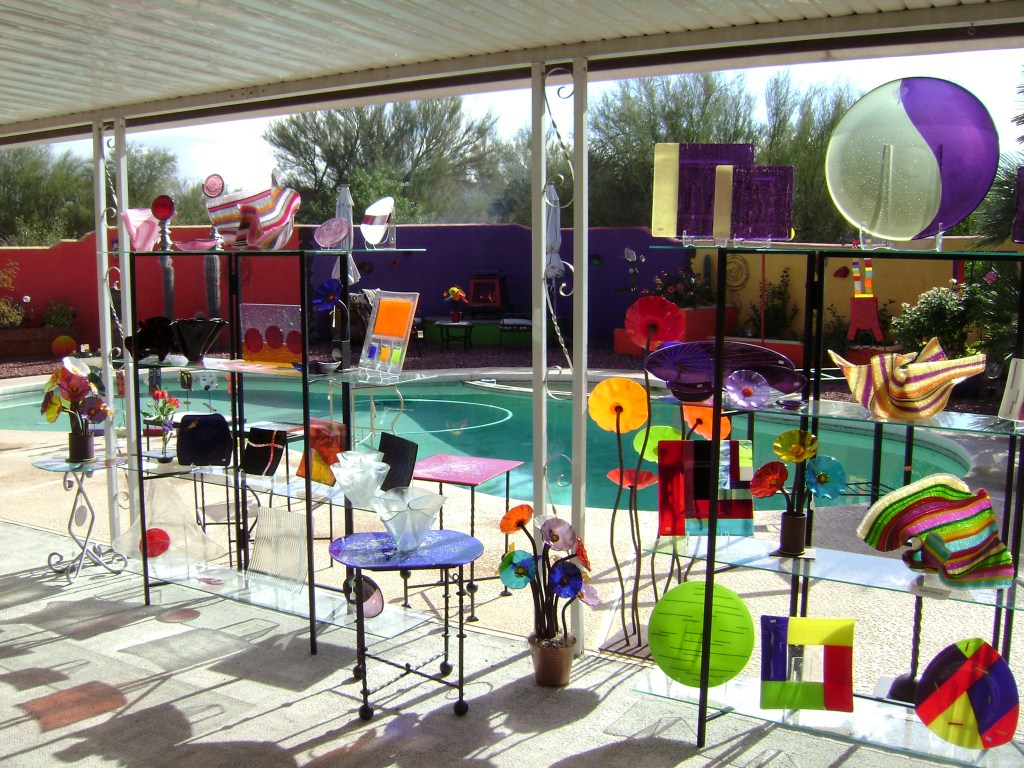
Courtesy of Carole Perry
Learn to express yourself
Hidden in the Hills has grown immensely since its inception in 1997, Perry explains. The idea for a studio tour was spurred after a member returned from one in Northern California.
“We just went crazy in love with the idea of an open studio tour where people came to us instead of us packing up and putting ourselves under a tent on the street,” Perry says.
The first tour included 16 studios and 35 artists. The budget was $250, which they used to mimeograph and mail a map listing artist studios.
Today, the event has a significant impact on the local economy, Perry notes. “We do over a million dollars in sales based on surveys of the artists,” she says, from a $25 box of cards to $15,000 sculptures.
Not only does it draw thousands who spend money at the studios, local shops and restaurants, but they might also make bigger purchases — like a house.
“I can name five people who moved up here after I met them at Hidden in the Hills,” she says.
Page is one of them. Originally from Argentina, he was based in New York City and Hoboken, New Jersey, and came to Arizona 15 years ago. He heard about the artists’ community in Cave Creek and the Hidden in the Hills tour.
“When I started looking for a place to buy, I knew I wanted to be here,” he says. “I am very happy about the decision.”
Page says one of the themes he sees at the annual tour is the gratitude people express for being able to witness the creative process. Many people don’t have the opportunity to express themselves, let alone make a living at it, and the tour encourages them to explore their own creativity.
“Art endures,” Page says. “It’s inspirational for a lot of people.”