
Miriam Wasser

Audio By Carbonatix
It’s 5:30 p.m. at the Arizona Senate. Do you know where your state senator is?
Wednesday afternoon, a packed Arizona Senate committee hearing was left hanging for hours as the sponsor of one of the session’s most controversial bills — which would criminalize community members alerting their neighborhoods to the presence of Immigration and Customs Enforcement agents — was nowhere to be found.
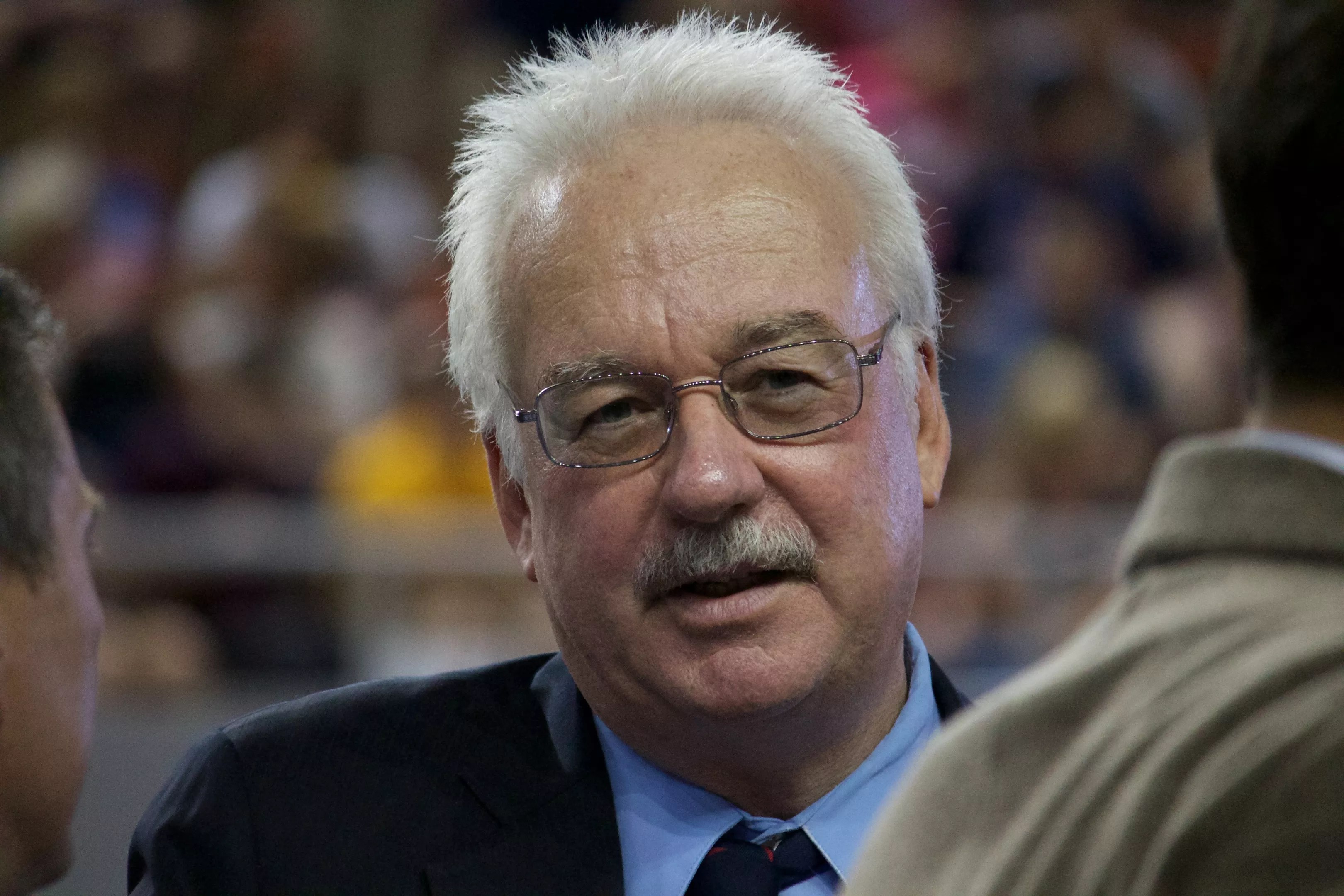
Instead, the lawmaker, veteran GOP state Sen. John Kavanagh, was appearing on a popular local radio show on the other end of town.
Kavanagh’s bill, Senate Bill 1635, was due to be considered in the Senate Judiciary and Elections Committee on Wednesday, along with more than 50 other bills. SB 1635 was scheduled to be the 23rd bill considered in what turned out to be a marathon hearing that drew immigration activists and other members of the public prepared to speak against it.
But by the time Kavanagh’s bill came up, he was gone.
On the recording of the hearing, Kavanagh could be seen leaving the hearing room around 4 p.m., about an hour and a half into the hearing. He didn’t return for more than two and a half hours. In the meantime, the committee chair and GOP state Sen. Wendy Rogers kept delaying bills on the agenda — including Kavanagh’s — because Kavanagh’s vote would be needed to advance them. Without him, they’d have died a premature death with a 3-3 committee vote.
Where was he? Anyone watching the livestream of KTAR’s popular radio show “Outspoken with Bruce & Gaydos” certainly knew. There was Kavanagh in KTAR’s studio, which is located 25 minutes away from the Arizona Capitol. He sat for the entire nearly hour-long segment of the “5 O’Clock Faceoff” with legal analyst Barry Markson to discuss the federal SAVE Act, ICE scanning license plates, Arizona’s school vouchers, Stephen Colbert and more.
At the Capitol, his absence created some confusion. At 5:30 p.m., the committee paused the hearing to grab dinner. At that point, Democrat state Sen. Analise Ortiz overheard Rogers expressing concern at Kavanagh’s whereabouts, including her fear that he may have gotten in a car accident. Ortiz then pulled up KTAR’s livestream and showed Rogers the video of Kavanagh on the show.
“It was very clear that she had no idea where he was,” Ortiz told Phoenix New Times. “She was shocked and not happy.”
Rogers did not respond to a request for comment from New Times. But in an email, Kavanagh disputed the notion that his dipping out for a radio hit caught anyone by surprise.
“I was on the show as an official representative of the Republican Caucus as part of our media outreach program,” Kavanagh wrote. “Everyone knew, and I turned over my vice-chair duties to Senator (Shawnna) Bolick before leaving. They deferred voting on the discussed bills until I returned.”
Excused or not, Kavanagh’s absence certainly caused the hearing to drag on. With bills being delayed for the last two hours, many members of the public and Ortiz were confused about whether SB 1635 would be heard on Wednesday evening or Friday morning, when the next committee hearing was scheduled. Many who had been waiting hours to speak against his bill decided to leave.
But after the 45-minute dinner recess, Kavanagh sauntered back into the committee hearing a little after 6:20 p.m. Rogers immediately put SB 1635 up for a discussion and vote to a now nearly-empty room. Ortiz felt Rogers misled the public in the process.
“There was an attempt to signal to the community that the bill was not going to be heard on Wednesday,” Ortiz told New Times. “When we’re doing things outside of normal procedure, it’s very confusing (to the public). We should not be legislating that way.”
Finally present to speak about his bill, Kavanagh insisted it has been “misportrayed.” He claimed the bill wouldn’t make it illegal for people to give “general warnings” about law enforcement activity in an area, but was instead focused on outlawing direct warnings to a person who is the subject of an “imminent arrest.”
“Putting a text message out: ICE is in the area. Blowing whistles: ICE is in the area. None of that behavior is made illegal by this bill,” Kavanagh claimed during the hearing. “That is First Amendment-protected speech.”
That doesn’t match up to the bill’s text or with Kavanagh’s previous statements. Earlier this month, he told New Times that rapid response groups posting ICE alerts on social media “could” run afoul of his proposed law. The bill still widely defines “communicates” as basically anything, including gestures, electronic communication and whistles or bell sounds.
After Rogers put SB 1635 up for discussion, community members rushed back into the room in the hopes of testifying against it. The proceedings instantly got testy. Rogers prevented Ortiz from asking questions about ICE’s violence. Kavanagh got into an intense back-and-forth with an attorney testifying. During the final community member’s testimony, people in the audience began chanting, “No justice, no peace, no ICE on our streets,” with their fists up in the air. At the threat of arrest, the group then walked out of the room while continuing to chant.
After another recess, hours after it was initially set to be considered, the bill advanced along party lines.
“The sponsor of a very harmful bill, leaving the committee and leaving everybody kind of waiting around, it really sends the message that he doesn’t care what they think,” Ortiz said. “And it’s disrespectful.”