
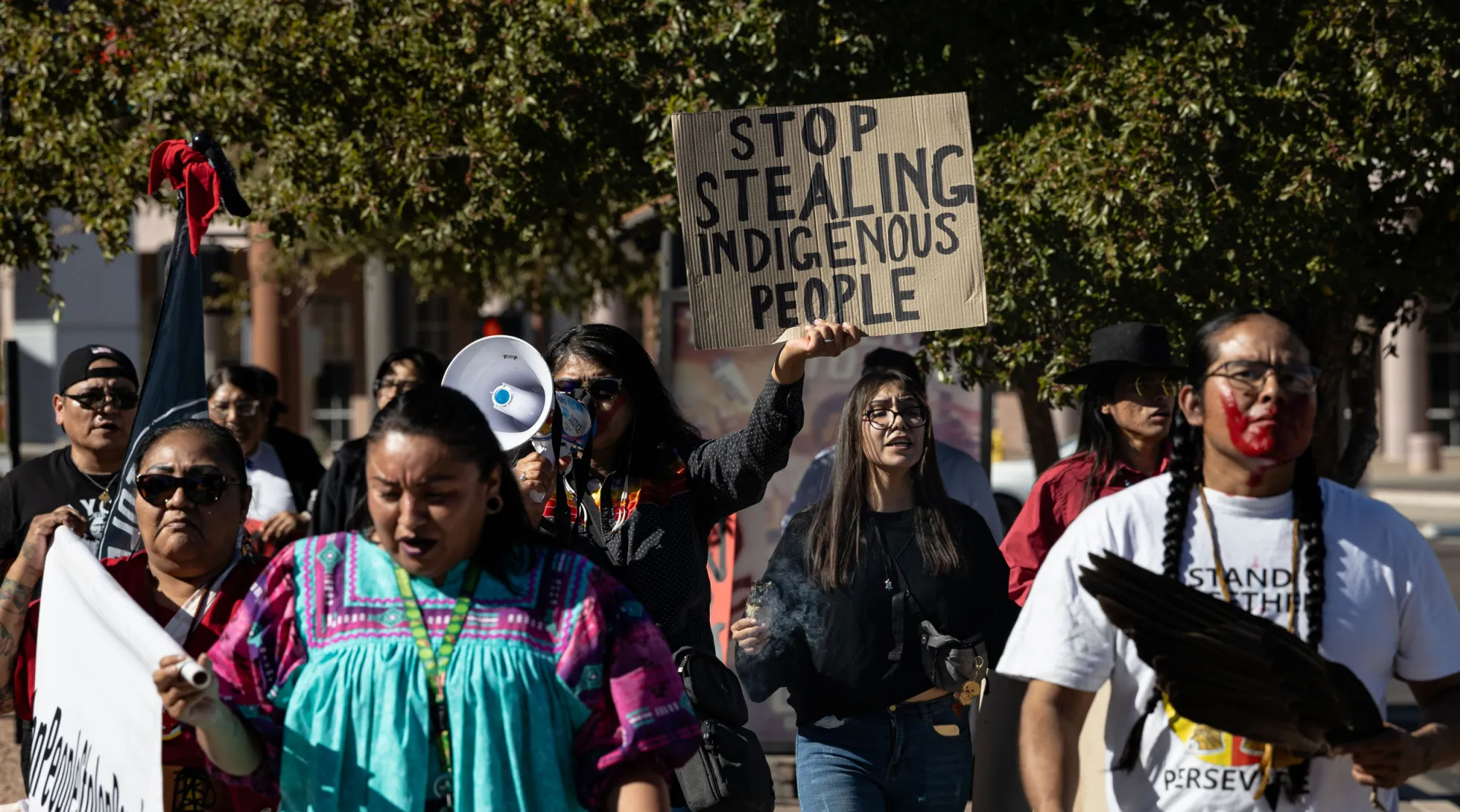
Christopher Lomahquahu/AZCIR

Audio By Carbonatix
This story was originally published by the Arizona Center for Investigative Reporting.
Nearly three years after Arizona uncovered an unprecedented $2.5 billion Medicaid fraud scandal that targeted Indigenous communities, sober living program operators are still recruiting vulnerable residents into sham treatment programs and billing the state for questionable behavioral health services.
Though Arizona Health Care Cost Containment System officials say the crisis has stabilized in response to ongoing investigations into providers, they acknowledge that fraudulent activity continues.
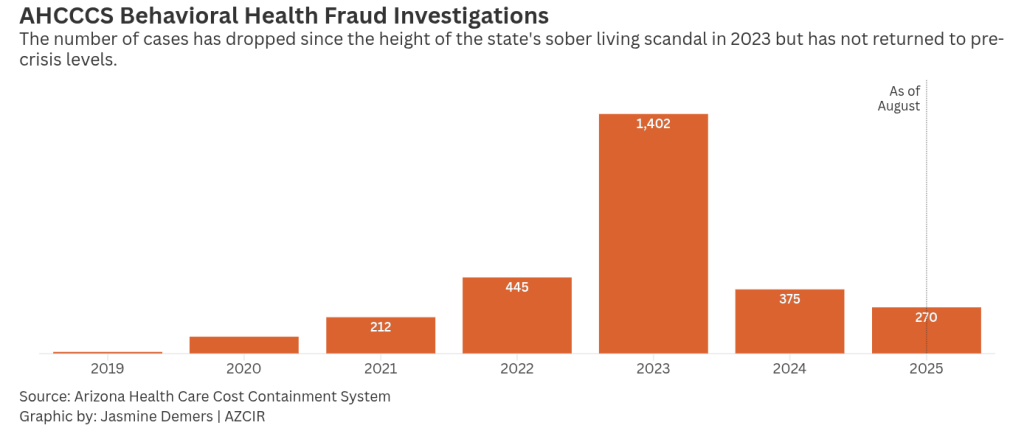
New behavioral health fraud investigations had dropped from about 1,400 at the scandal’s peak in 2023 to 270 as of August 2025, according to AHCCCS. The figures include both civil and criminal cases, with some providers facing multiple investigations. By comparison, just nine cases were opened statewide in 2019, before the scheme came to light. Agency leaders say that decline reflects new safeguards, tighter billing controls and aggressive enforcement.
But lawmakers, providers and tribal advocates contend the numbers tell only part of the story, as systemic oversight gaps persist and legitimate care for vulnerable patients is disrupted by payment freezes to address fraud. With investigations still open and AHCCCS undergoing its third leadership change since the crisis began, critics question whether the agency has effectively addressed the structural failures that allowed the fraud to flourish.
“Despite public exposure, investigations, lawsuits, media coverage and legislative attention, the same harmful practices remain active,” said Reva Stewart, a Diné activist who has become a central voice for Indigenous communities affected by the crisis. “The system has not been fixed. It has only adapted.”
Fraudulent providers continue to recruit people with American Indian Health Program coverage through social media and informal networks, steering them into unstable substance use treatment programs and billing arrangements designed to maximize Medicaid payments, Stewart said. Her nonprofit, Turtle Island Women Warriors, does on-the-ground outreach and works with victims and their families to report fraud.
“This recruitment is happening in plain sight. It is ongoing, it is organized, and it is being used to funnel people into unstable, unsafe and exploitative environments for financial gain,” she said. “Why is this still being allowed to happen when regulators have known about this practice for years?”
Previous investigations by the Arizona Center for Investigative Reporting and ProPublica found that at least 40 Indigenous residents of Phoenix-area sober living homes and treatment facilities died between 2022 and 2024, as state officials struggled to respond to mounting evidence of widespread fraud. AHCCCS has yet to account publicly for the number of deaths tied to the scheme.
Since August, lawmakers on the Senate’s Health and Human Services Committee have convened a series of oversight hearings to scrutinize AHCCCS’ fraud response and identify weaknesses. During the hearings, behavioral health providers testified that hundreds of thousands of dollars in claims had been delayed or withheld under heightened fraud controls, forcing them to reduce services, treat patients without reimbursement or consider shutting down altogether.
Aimee Graves, chief executive officer of The Haven, a substance use recovery center for women in Tucson, said AHCCCS owes her organization more than $375,000 for services provided to Native American members since October 2023. That shortfall forced the center to reduce the number of available beds last fall.
“There is a severe and persistent access to care (issue) for Native and Indigenous women that we have seen at the Haven,” Graves said. “We absolutely need to be paid in order to keep our doors open and to be able to continue providing these high quality care treatment and programming services.”
She said delays in approving services for Native American patients have continued, even after several one-on-one meetings with AHCCCS leaders.
Agency officials, however, have defended their response, saying AHCCCS is required by law to act when potential fraud is detected, including suspending providers and placing claims under prepayment review. They said the vast majority of claims are paid without delay, and that less than 1% of claims have to go through the review process.
“We know that we’re not completely out of the woods,” Marcus Johnson, AHCCCS deputy director of community engagement and regulatory affairs, said during a hearing. “But we have really gotten through the acute crisis phase of the sober living fraud.”
Arizona Center for Investigative Reporting
Medicaid fraud history
The fraud at the center of the scandal emerged between 2019 and 2023, when thousands of unlicensed sober living homes and behavioral health providers started exploiting gaps in Arizona’s Medicaid system—particularly within the American Indian Health Program. Operators recruited members of Indigenous communities with promises of treatment, housing and transportation, then billed AHCCCS for services that were never provided.
By the time the state publicly acknowledged the fraud in May 2023, the Medicaid system had already paid out billions of dollars in fraudulent claims. The federal Department of Health and Human Services has described it as the largest fraud scheme to have targeted a single demographic group in recent U.S. history.
In an effort to stem the losses, AHCCCS suspended hundreds of providers in 2023 and enacted policies that halted or substantially delayed payments to those still operating. Previous reporting by AZCIR and ProPublica showed the state’s aggressive response left hundreds of patients homeless and without treatment.
The agency struggled to rein in the crisis under several leaders. Records show that under former Director Jami Snyder, who stepped down in late 2022, AHCCCS failed to alert the public even after receiving warnings that patients were being harmed. Her successor, Carmen Heredia, resigned last May ahead of a confirmation hearing where she was expected to face questions from lawmakers about her handling of the fallout. Early this February, Director Virginia “Ginny” Rountree announced plans to leave after just four months in the role, citing health reasons.
Meanwhile, the Arizona Attorney General’s Office, which is leading the criminal investigations into fraudulent providers, has so far recovered less than 6% of the taxpayer funds lost to fraud. The attorney general is also representing the state in a class action lawsuit filed on behalf of thousands of victims.
According to lawmakers, the recent Senate oversight hearings have revealed not just past failures but ongoing structural problems at AHCCCS, setting the stage for a wave of legislation aimed at reshaping how the agency oversees behavioral health care and the American Indian Health Program.
Among the most consequential proposals is a bill that would require AHCCCS to contract with an outside entity to help administer AIHP. The agency would still oversee the program, but day-to-day administration and care coordination would shift to a managed care organization—like Mercy Care or UnitedHealthcare—starting in October 2027. Those organizations would have the opportunity to compete for the contract.
“AHCCCS’ testimony and written response to this committee confirms that the agency, in its dual role as Medicaid authority and the operational health plan for AIHP, is not adequately equipped to protect the safety of tribal members or the stability of the behavioral health system that serves them,” said Sen. Carine Werner, who introduced the bill. The Scottsdale Republican, who also chairs the oversight committee, said testimony from the hearings exposed deep breakdowns in the way AHCCCS operates the program.
“I do believe the system is so broken that there’s no going back,” Werner said.
For Stewart, the Indigenous community advocate, the proposal to shift at least some management of AIHP to an external contractor is a welcome one, and a step she believes is necessary to get rid of bad actors for good.
“I really think that is a legitimate solution,” she said. “We’ve been pushing this for the last three years and asking for something to happen.”
Tao Etpison, vice chairman of the San Carlos Apache Tribal Council, said during a committee meeting in February that the tribe supported the legislation in principle, but recommended several changes to the bill’s language.
“Our goal is to ensure that the law is clear, that it honors tribal sovereignty and federal obligations, and that our members can continue to receive timely, culturally appropriate, effective care,” he said.
An AHCCCS spokesperson said agency officials are analyzing the bill and its potential impact, “including the likelihood of significant additional costs to the state.” They also expressed concern about the timeline of the bill’s implementation during the committee hearing, saying it’s not in alignment with federal requirements or their tribal consultation policy.
Werner has introduced several other AHCCCS-related bills this session, including efforts to roll back or limit prior authorization requirements for behavioral health services under AIHP, tighten claims review processes and prohibit agency employees from working from home.
“My hope, my prayer, is that the legislature will seize this moment,” Etpison said. “Close the loopholes, enforce real penalties, place tribes at the center of decision making and restore integrity to a system that must once again serve life and not exploit it.”