
Richard N Horne/Wikimedia Commons/CC BY-SA 4.0

Audio By Carbonatix
Just more than a year after a fatal plane crash involving a private jet at Scottsdale Airport, everybody involved seems to be blaming everyone else for the accident. Despite the finger-pointing, all of those people seem to agree that Scottsdale is also at fault.
Last week Phoenix New Times reported on two lawsuits over the Feb. 10, 2025, plane crash, in which a Learjet owned by Motley Crue singer Vince Neil veered off the runway and hit a parked Gulfstream, killing the first plane’s pilot. (Neil was not on board.) Now two more lawsuits have been filed related to the crash — including one by Chromed in Hollywood, the Neil-backed company that owned the wayward jet.
Those four lawsuits form something of a circular firing squad. Defendants in one suit are plaintiffs in another, each saying responsibility lies with the other parties. But all four lawsuits also name Scottsdale, which owns and operates the airport, as a defendant.
Attorneys for many of the involved parties did not respond to requests for comment from Phoenix New Times. The city of Scottsdale and the attorney for the Gulfstream’s owners declined to comment.
The previous two complaints were filed by Ashley Rosile, a passenger on the Learjet that veered off the runway on landing, and by Allianz Global Risk, which insured the Gulfstream that was totaled after the out-of-control Learjet crashed into it. The new complaints were filed by Chromed in Hollywood, which owned the Learjet, and WW Aviation and Jet Pros, which owned and operated the Gulfstream. Joseph Dumont, the pilot of the Gulfstream who was onboard at the time of the crash, is also a plaintiff in the latter suit.
Central to the two lawsuits are two distinct claims.
The first concerns a malfunction of the Learjet’s landing gear, which is not under dispute. The National Transportation Safety Board’s preliminary accident report from Feb. 25, 2025, found that as the Learjet approached the runway for landing on Feb. 10, its left landing gear did not deploy directly and instead dragged behind its proper position. Upon landing, the malfunctioning landing gear caused the Learjet to careen to the left, putting it on a collision course with the parked Gulfstream.
Two of the four lawsuits — the suits from the Gulfstream’s owners and from the Gulfstream’s insurer — claim that the malfunction was the result of negligence. They claim Chromed in Hollywood improperly maintained the Learjet, pointing to a rough landing seven months prior that resulted in tires on the left landing gear exploding. They also claim pilot Joie Vitosky, who died in the crash, improperly operated the jet.
Though the NTSB report says that “the flight crew did not make any radio calls indicating they were aware that the landing gear may not be operating correctly,” the two suits against Chromed in Hollywood claim that the Learjet’s cockpit voice recorder captured discussion — though it’s not clear between whom — about “strange noises heard by its occupants, as well as discussion about the landing gear.” Those suits also fault Vitosky and his first officer for not deploying the jet’s drag chute, which they claim would have prevented the crash with the other plane.
Court documents
Runway safety questions
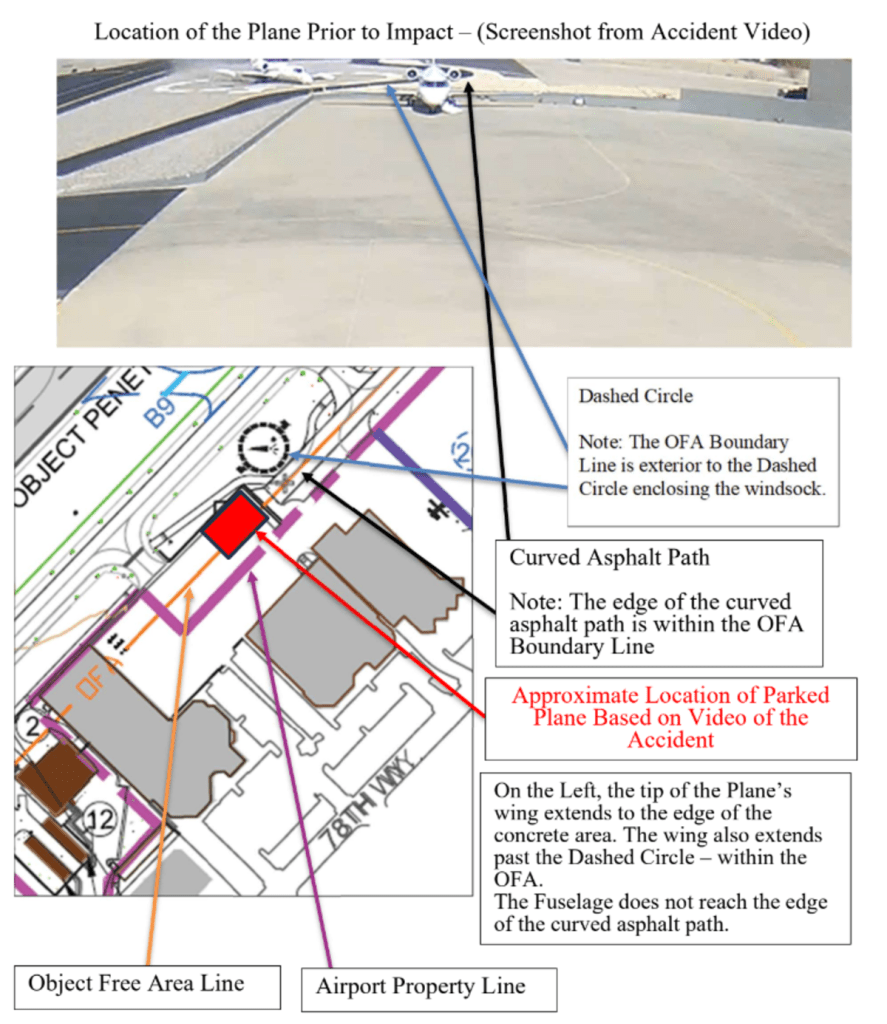
What all four lawsuits agree upon, however, is that Scottsdale Airport negligently allowed planes to be parked too close to the runway, making an accident like the one from last year all the more likely.
Those claims specifically hinge on what’s called an Object Free Area, an important boundary that extends beyond the runway. Most objects that could cause a crash (including parked planes) are supposed to be outside of the Object Free Area. Nearly everyone involved in the lawsuits — including the owners of both jets, but not including Scottsdale — agrees that the Gulfstream was parked inside the Object Free Area and therefore in harm’s way.
The suits filed by Chromed in Hollywood and Rosile, who was aboard the malfunctioning Learjet, partially blame the Gulfstream’s owners and pilot for allowing the plane to be parked there. Notably, Rosile has not sued Chrome in Hollywood over the Learjet’s landing gear malfunction, despite that being the most obvious proximate cause of the crash.
The Gulfstream’s owners also say it shouldn’t have been parked there. They blame the airport and Southwest Jet Center, a private company that operates the hangar at which the Gulfstream was parked and allegedly moved the plane into its position at the time of the crash. All four lawsuits target Scottsdale for failing to prevent the plane from being parked there. Some of the suits note that the airport’s air traffic control tower had a clear line of sight to the Gulfstream and should have ordered the plane moved.
Several questions are not addressed by the four lawsuits. It is not clear what specific policies Scottsdale Airport and the Federal Aviation Administration have about parking planes near the airport’s lone runway. (The FAA has not yet provided specifics about policies for the airport.) Nor is it clear whether there was any communication between the Gulfstream’s owners, Southwest Jet Center, and airport or FAA personnel about moving the jet into that particular parking spot.
If the suits progress — and odds are they will be consolidated into one case — that information may be revealed.
The preliminary NTSB report did not mention Object Free Areas, but the agency’s investigation into the crash is going and may not be completed for several months. Until its final report comes out, one thing appears clear: Expect lots of courtroom jockeying about whose fault the fatal plane crash really was.