
Mario Tama/Getty

Audio By Carbonatix
The winter months in Phoenix are historically dry. Most of our rainfall comes during the summer monsoon — and thank goodness for that — but the cooler months in the Valley tend to be the drier months as well.
This morning, however, Valley residents awoke to wet driveways and rain-sprinkled cars. A storm system passed through Maricopa County overnight, giving the area its first measurable rainfall since Jan. 8. It wasn’t much — Phoenix Sky Harbor International Airport, where the National Weather Service takes its measurements, got only 0.08 inches — but it wasn’t nothing, either.
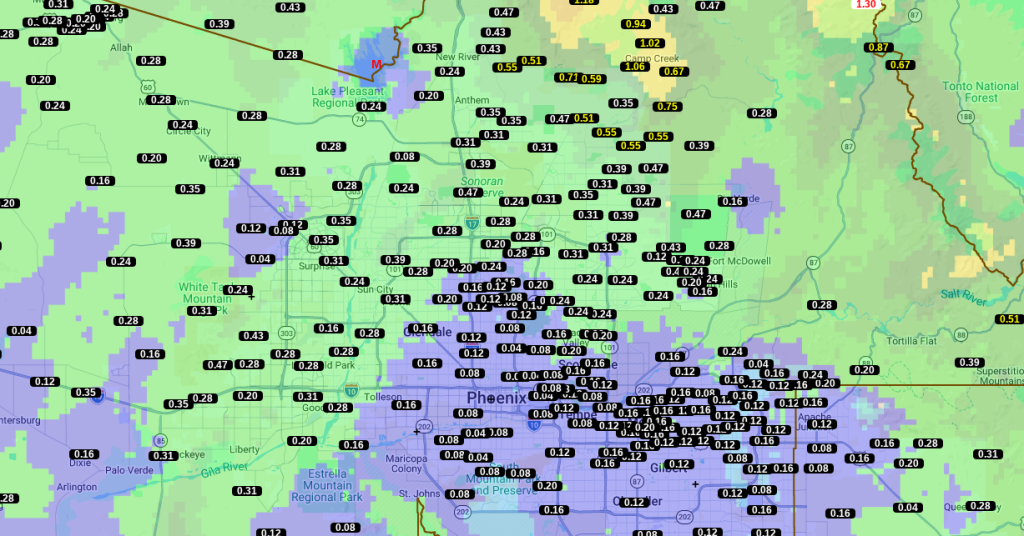
The Maricopa County Flood Control District offers a detailed map of rainfall data collected from its network of rain gauges around the Valley. While Sky Harbor might not have seen much rain, other areas of the Valley were doused more significantly.
Maricopa County Flood Control District
For the most part, central Phoenix and the East Valley got a mere dusting of rain — less than a fifth of an inch in most cases, sometimes less than a 10th of an inch. But it rained harder in the West Valley, with Surprise getting roughly a third of an inch and the area north of Sun City receiving nearly 0.40 inches.
If you happened to be in the far northern reaches of the Valley, you got a proper rainstorm. The Cave Creek area got between a half inch and 0.75 inches of rain last night. The mountains north of that got an inch or more.
Officially — meaning, according to the NWS gauge at the airport — the Valley has received .26 inches of rain this year. That’s already well ahead of 2025, which saw only 0.3 inches of rain over the first two months of the year. We have a lot of catching up to do if we want to match 2024 and 2023, though: The former enjoyed more than two inches of rain in January and February, while the latter received 1.41 inches over its first two months.
Last year’s meager early rainfall isn’t necessarily a bad omen, though. Despite the dry start to the year, 2025 wound up as the wettest year the Valley had seen since 2018.